Dr. Swati Mhaske's Jija Clinic
Expert Obstetrician & Gynecologist in Pimple Saudagar
10+ years of compassionate care for pregnancy, PCOS/PCOD, fertility & women's health. Consult now — appointments open Mon–Sat, 10 AM to 8 PM.
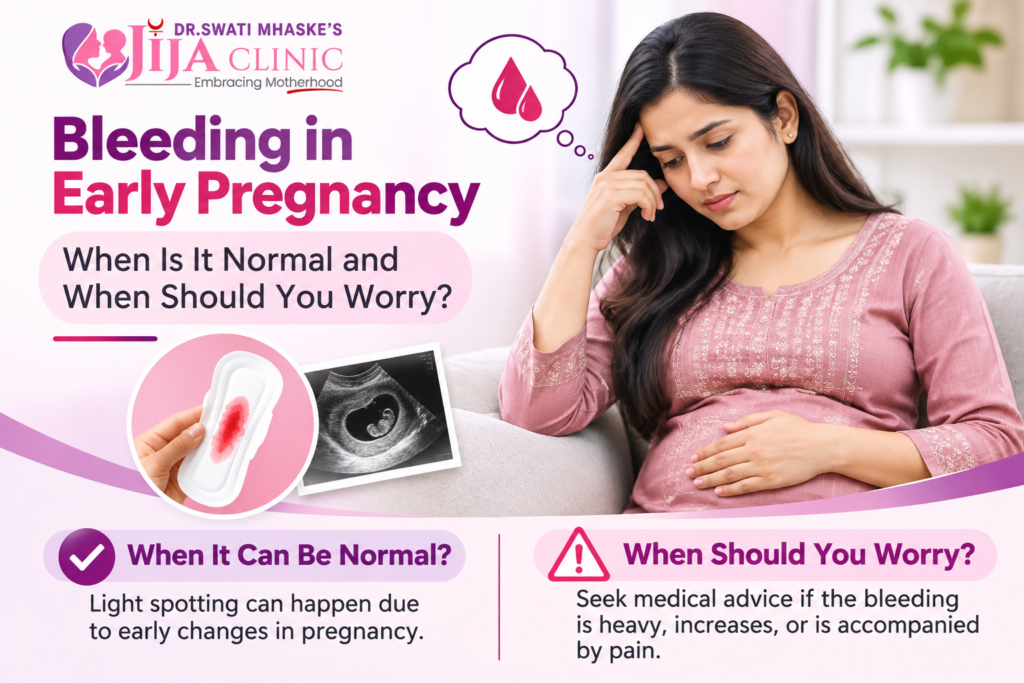
Bleeding in Early Pregnancy: When Is It Normal and When Should You Worry?
Seeing blood when you are pregnant can be frightening. The first question most women ask is, “Is my baby okay?” The reassuring news is that light bleeding or spotting in early pregnancy is fairly common, and many women who experience it go on to have healthy pregnancies.
However, bleeding can sometimes be a sign of a problem that needs prompt care. This guide explains the common causes of bleeding in the first trimester, how to tell what’s likely harmless, and when to see your doctor right away.
Quick answer: Light spotting or bleeding in the first trimester happens in roughly 1 in 4–6 pregnancies and is often harmless, for example implantation bleeding or cervical changes. But because it can also be a sign of miscarriage or an ectopic pregnancy, any bleeding in pregnancy should be checked by your gynaecologist, and heavy bleeding or pain needs urgent care.
Go to the hospital immediately if you have:
- Heavy bleeding that soaks a pad in an hour or less
- Passing clots or tissue
- Severe pain or cramping in the abdomen, especially on one side
- Pain in the shoulder tip
- Dizziness, fainting or a racing heartbeat
- Fever or chills along with bleeding
How Common Is Bleeding in the First Trimester?
Bleeding in the first 12 weeks of pregnancy is quite common. Studies suggest about 15–25% of pregnant women have some bleeding in the first trimester. Light spotting that settles on its own is often not a sign of a serious problem, but only an examination can confirm that.
Spotting vs Bleeding: What’s the Difference?
- Spotting is a few drops of blood, enough to notice on underwear or when you wipe, but not enough to fill a pad.
- Bleeding is a heavier flow that needs a pad to stay dry.
Both should be reported to your doctor, but heavier bleeding needs faster attention.
Implantation Bleeding vs Period: How to Tell
Implantation bleeding can happen when the fertilised egg attaches to the wall of the uterus, usually about 10–14 days after conception, around the time your period would be due. That’s why it’s often mistaken for a light period.
Feature | Implantation bleeding | Period |
Timing | Around or just before your expected period | On or around your expected date |
Colour | Light pink or brown | Bright red, then darker |
Flow | Very light spotting | Starts light, becomes heavier |
Duration | A few hours to 1–2 days | Usually 3–7 days |
Clots | No | Can have clots |
Cramps | Mild or none | Often moderate cramps |
If you think you might be pregnant and have unusual light bleeding, take a home pregnancy test a few days later or see your gynaecologist.
Common Causes That Are Usually Harmless
- Implantation bleeding: light spotting when the embryo attaches to the uterus.
- Cervical changes: during pregnancy, more blood flows to the cervix, making it softer and more likely to bleed lightly.
- After intercourse or an internal examination: the sensitive cervix can spot slightly afterwards.
- Hormonal changes: some women have light spotting around the time their period would have been due.
Even when the cause turns out to be harmless, it should be confirmed by your doctor.
Serious Causes Your Doctor Will Rule Out
Miscarriage
Bleeding with cramping, passing clots or tissue can be a sign of miscarriage. Not all bleeding means a miscarriage, but it needs prompt evaluation. Most early miscarriages happen because of chromosomal problems and are not caused by anything the mother did.
Ectopic pregnancy
This is when the pregnancy implants outside the uterus, most often in a fallopian tube. Warning signs include bleeding with one-sided abdominal pain, shoulder-tip pain, dizziness or fainting. An ectopic pregnancy is a medical emergency.
Subchorionic haematoma
A collection of blood between the uterus wall and the pregnancy sac. It can cause bleeding and is often seen on ultrasound. Many settle on their own, but your doctor will monitor it.
Molar pregnancy
A rare condition where abnormal tissue grows instead of a normal pregnancy. It may cause bleeding, severe nausea and a uterus larger than expected. It’s diagnosed on ultrasound and blood tests.
Infections
Vaginal or cervical infections can cause spotting and need treatment.
What the Colour of the Blood Can Tell You
Colour | What it may mean |
Pink | Often light spotting, e.g. implantation or cervical irritation |
Brown | Older blood leaving the body; often less concerning, but still worth reporting |
Bright red | Fresh, active bleeding; needs prompt review, especially if heavy or with pain |
Colour alone can’t tell you the cause. Always have bleeding checked.
What Your Gynaecologist Will Check
When you visit with bleeding, your doctor may:
- Ask about the bleeding: when it started, how heavy it is, its colour, and any pain.
- Do an examination to check the cervix and the source of bleeding.
- Do an ultrasound (usually transvaginal in early pregnancy) to see where the pregnancy is and check for a heartbeat when it’s early enough to see one.
- Do blood tests: beta-hCG levels, sometimes repeated after 48 hours to see how they change, and your blood group and Rh type.
- Give anti-D injection if needed: if you are Rh-negative, your doctor may advise an anti-D injection to protect future pregnancies.
What to Do While You Wait for Your Appointment
- Call your gynaecologist and describe the bleeding.
- Use a sanitary pad, not a tampon or menstrual cup, so you can see how much you are bleeding.
- Note the amount, colour and any clots to tell your doctor.
- Rest and avoid heavy lifting.
- Avoid intercourse until your doctor has checked you.
- Don’t take any medicine without your doctor’s advice.
If bleeding becomes heavy or you develop severe pain, dizziness or fever, go to the hospital immediately.
Bleeding in the Second and Third Trimester
Bleeding later in pregnancy is less common and is always taken seriously. Causes can include a low-lying placenta (placenta previa), separation of the placenta (placental abruption) or early labour. If you have any bleeding after the first trimester, contact your doctor or go to the hospital right away.
Can You Prevent Bleeding in Early Pregnancy?
Most causes of early pregnancy bleeding can’t be prevented. But regular antenatal care helps catch problems early:
- Book your first pregnancy visit as soon as you test positive.
- Take folic acid and other supplements as prescribed.
- Get thyroid, blood sugar and blood group checked early.
- Avoid smoking, alcohol and unprescribed medicines.
- Report any bleeding, pain or unusual discharge promptly.
Worried About Bleeding in Pregnancy? Talk to Dr. Swati Mhaske
Dr. Swati Mhaske (MBBS, DGO, FICOG – Reproductive Medicine) is an obstetrician and gynaecologist in Pimple Saudagar, Pune, providing complete pregnancy care, including early pregnancy assessment and high-risk pregnancy management.
Call for an appointment: +91 88880 14112
Avenue Plaza, 2nd Floor, Pimple Saudagar, Pune 411017
For heavy bleeding, severe pain or fainting, go to the nearest hospital emergency immediately.