Dr. Swati Mhaske's Jija Clinic
Expert Obstetrician & Gynecologist in Pimple Saudagar
10+ years of compassionate care for pregnancy, PCOS/PCOD, fertility & women's health. Consult now — appointments open Mon–Sat, 10 AM to 8 PM.
How Many Days After Your Period Can You Get Pregnant?
If you are trying to conceive, timing matters. You can only get pregnant on a few days in each menstrual cycle, and knowing which days those are can make a real difference. If you are trying to avoid pregnancy, it’s just as important to understand why “safe days” are not as safe as many people think.
In this guide, we explain how your cycle works, how to work out your fertile days for your cycle length, and when it’s time to see a gynaecologist.
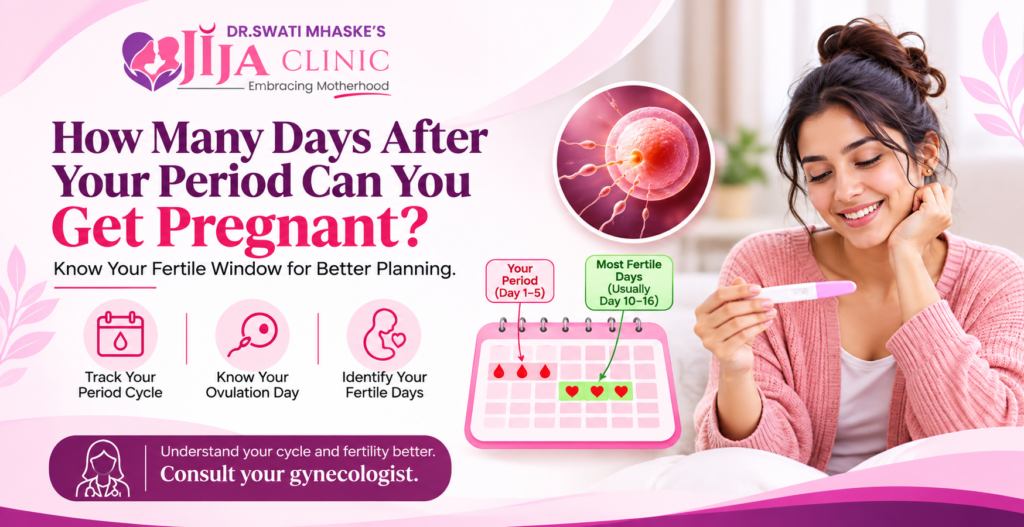
Quick answer: In a regular 28-day cycle, ovulation usually happens around day 14, counting the first day of your period as day 1. Your most fertile days are about day 9 to day 14, the 5 days before ovulation plus ovulation day. If your cycle is shorter or longer, your fertile window moves earlier or later, so it’s important to calculate it for your own cycle.
Understanding Your Menstrual Cycle
Your menstrual cycle starts on the first day of your period and ends the day before your next period begins. A normal cycle can be anywhere from about 21 to 35 days. It has four phases:
- Menstrual phase: your period, usually 3–7 days.
- Follicular phase: the ovaries prepare an egg to be released.
- Ovulation: a mature egg is released from the ovary. This is when you are most likely to conceive.
- Luteal phase: the time from ovulation until your next period, usually about 14 days.
The key fact to remember: ovulation usually happens about 14 days before your next period starts, not 14 days after your last one. That is why the timing changes when your cycle length changes.
Why You Can Only Get Pregnant on Certain Days
Pregnancy needs a sperm and an egg to meet:
- After ovulation, the egg survives for about 12–24 hours.
- Sperm can survive up to about 5 days inside the body.
So your fertile window is roughly 6 days: the 5 days before ovulation and the day of ovulation. The 2–3 days just before ovulation, and ovulation day itself, carry the highest chance of conception.
When Is Your Fertile Window? (By Cycle Length)
Use this table to estimate your fertile days. Day 1 is the first day of your period.
|
Cycle length |
Likely ovulation day |
Fertile window |
Most fertile days |
|
24 days |
Around day 10 |
Day 5 – 10 |
Day 8 – 10 |
|
26 days |
Around day 12 |
Day 7 – 12 |
Day 10 – 12 |
|
28 days |
Around day 14 |
Day 9 – 14 |
Day 12 – 14 |
|
30 days |
Around day 16 |
Day 11 – 16 |
Day 14 – 16 |
|
32 days |
Around day 18 |
Day 13 – 18 |
Day 16 – 18 |
|
35 days |
Around day 21 |
Day 16 – 21 |
Day 19 – 21 |
How to calculate it yourself: Take your usual cycle length and subtract 14. That gives your likely ovulation day. Your fertile window is the 5 days before it plus that day.
Example: If your cycle is 30 days, 30 − 14 = 16. You likely ovulate around day 16, and your fertile window is about day 11 to day 16.
These are estimates. Ovulation can shift from month to month because of stress, illness, travel, weight changes or hormonal conditions.
Can You Get Pregnant Right After Your Period?
Yes, it’s possible, though less likely. It can happen when:
- Your cycle is short (21–24 days), so ovulation comes soon after your period ends.
- Your period is long, so the end of it overlaps with your fertile window.
- Sperm survive for several days, so intercourse near the end of your period can lead to pregnancy if you ovulate early.
- Your cycles are irregular, making it hard to predict ovulation.
Signs of Ovulation to Watch For
Your body often gives clues that ovulation is near:
- Clear, stretchy, slippery cervical discharge, like raw egg white
- A slight rise in body temperature after ovulation (seen with daily basal body temperature tracking)
- Mild one-sided lower abdominal pain or twinges
- Breast tenderness
- Increased sex drive
Not every woman notices these signs, and they are not precise enough on their own to pinpoint ovulation.
How to Track Your Fertile Days
|
Method |
How it works |
Good to know |
|
Calendar / period-tracking app |
Predicts ovulation from past cycle lengths |
Easy, but less accurate for irregular cycles |
|
Ovulation predictor kits |
Urine test detects the LH hormone surge 24–36 hours before ovulation |
Simple and useful for timing intercourse |
|
Basal body temperature (BBT) |
Daily morning temperature rises slightly after ovulation |
Confirms ovulation has happened, so best used over several months |
|
Cervical mucus changes |
Egg-white discharge signals fertile days |
Free, but takes practice to read |
|
Follicular study (ultrasound) |
Your gynaecologist tracks egg growth with serial scans |
The most accurate way to time ovulation, especially with irregular periods or PCOS |
Irregular Periods or PCOS? Why Calculation Becomes Unreliable
If your cycles vary a lot from month to month, or you often skip periods, calendar calculations won’t work well. Common causes include PCOS, thyroid problems, high prolactin, stress, and sudden weight gain or loss.
With irregular cycles, ovulation may happen late, unpredictably or not at all. A gynaecologist can find the cause, and tools such as a follicular study can show exactly when you ovulate. Learn more on our PCOS treatment and irregular menstrual cycle pages.
The “Safe Days” Myth
Many couples rely on “safe days” to avoid pregnancy. This is not a reliable method of contraception, because:
- Ovulation can come earlier or later than expected, even in regular cycles.
- Sperm can survive for up to 5 days.
- Stress, illness and travel can shift your cycle without warning.
If you want to avoid pregnancy, speak to your gynaecologist about a reliable contraceptive method that suits you.
Tips to Improve Your Chances of Conceiving
- Have intercourse every 1–2 days during your fertile window, especially the 2–3 days before ovulation.
- Start folic acid at least 1–3 months before trying, as advised by your doctor.
- Maintain a healthy weight. Both underweight and overweight can affect ovulation.
- Avoid smoking and alcohol, and limit caffeine.
- Manage stress and sleep well.
- Get existing conditions checked, such as thyroid, diabetes or PCOS, before trying.
When to See a Gynaecologist
Most couples conceive within a year of regular unprotected intercourse. See a gynaecologist or fertility specialist if:
- You are under 35 and haven’t conceived after 12 months of trying
- You are 35 or older and haven’t conceived after 6 months of trying
- Your periods are irregular, very painful or absent
- You have PCOS, endometriosis, thyroid problems or a history of pelvic infection
- You have had two or more miscarriages
- Your partner has a known sperm problem or a medical condition affecting fertility
Early evaluation can find simple, treatable causes and save valuable time.
Planning a Pregnancy? Talk to Dr. Swati Mhaske
Dr. Swati Mhaske (MBBS, DGO, FICOG – Reproductive Medicine) is an obstetrician, gynaecologist and fertility consultant in Pimple Saudagar, Pune. She helps women understand their cycles, evaluates fertility concerns, and guides couples with pre-conception care, ovulation tracking and fertility treatment where needed.
Book a consultation: +91 88880 14112
Avenue Plaza, 2nd Floor, Pimple Saudagar, Pune 411017