Dr. Swati Mhaske's Jija Clinic
Expert Obstetrician & Gynecologist in Pimple Saudagar
10+ years of compassionate care for pregnancy, PCOS/PCOD, fertility & women's health. Consult now — appointments open Mon–Sat, 10 AM to 8 PM.
Normal Delivery vs C-Section: Which Is Right for You?
As an obstetrician, one of the most common questions expecting mothers ask me is, “Doctor, will I have a normal delivery or will I need a C-section?” In Indian families, this question often comes wrapped in advice, anxiety, and a fair bit of well-meaning myth. So let me offer you a calm, honest answer: there is no single method that is “better” for everyone. The best delivery is the one that is safest for you and your baby. In this guide, I’ll explain both options clearly, their benefits and recovery, and how the decision is truly made.
What is a normal (vaginal) delivery?
A normal delivery, or vaginal birth, is when your baby is born through the birth canal, the way the body is naturally designed to give birth. Labour may begin on its own or be gently induced, and it involves contractions, the opening (dilation) of the cervix, and pushing. For most low-risk pregnancies, a normal delivery is what I aim for, because when things progress smoothly, it’s safe and recovery is quicker than many mothers expect.
What is a C-section (cesarean delivery)?
A C-section is a surgical procedure in which your baby is delivered through an incision in the abdomen and uterus, performed under regional (or occasionally general) anaesthesia. It usually takes less than an hour. Some C-sections are planned in advance for known medical reasons, while others become emergency decisions when labour takes an unexpected turn. Either way, a C-section is a safe, common, and often life-saving procedure.
Benefits of a normal delivery
When it’s safe, a vaginal birth offers some real advantages:
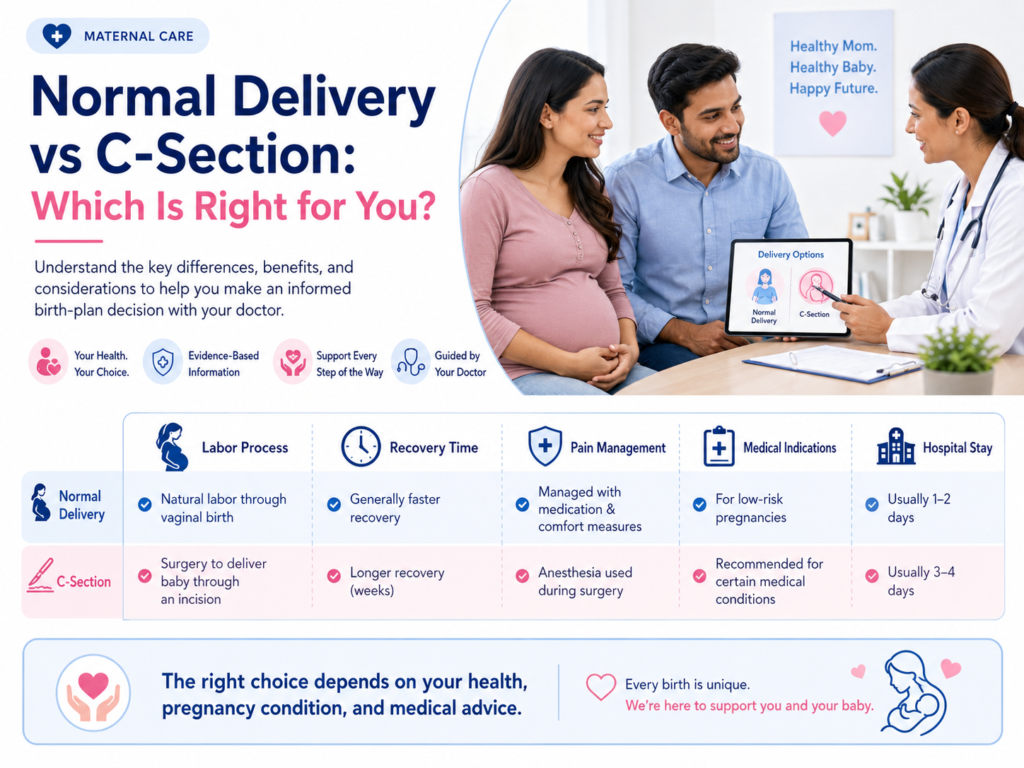
- Faster recovery and a shorter hospital stay (usually one to two days)
- No surgical incision to heal and fewer surgery-related risks
- Lower risk of infection and less post-operative pain
- Immediate skin-to-skin contact and often easier early breastfeeding and bonding
- Benefits for the baby, who is exposed to helpful bacteria in the birth canal and whose lungs clear fluid more effectively, which can mean fewer breathing difficulties
- Generally safer for future pregnancies, as there is no scar on the uterus
When is a C-section necessary?
A C-section becomes the safer choice in a number of situations, and I want mothers to understand these clearly so the decision feels less frightening. Common reasons include the baby being in distress, a breech or awkward position, placenta previa (a low-lying placenta), twins or multiples, very high blood pressure or preeclampsia, labour that isn’t progressing safely, the baby being too large for the pelvis, or a cord prolapse. In these cases, a C-section protects the health and life of mother and baby. It is a wise medical decision, never a failure.
Comparing recovery
Recovery differs mainly because one is a natural process and the other is surgery. After a normal delivery, most mothers are up and moving within hours, go home in a day or two, and recover relatively quickly. After a C-section, the hospital stay is typically three to five days, and complete healing of the incision takes a few weeks, with more caution around lifting and movement early on. In both cases, regular postnatal follow-up ensures healing is on track.
A word on painless delivery
Many mothers in India fear labour pain, and this fear alone sometimes makes them lean towards a C-section. I want to reassure you: with epidural (painless) delivery, a normal birth today is far more comfortable and manageable than it used to be. If pain is your main worry, please talk to me about it before deciding.
Busting common myths
Let me gently correct a few beliefs I hear often:
- “A C-section means I’m weak or have failed.” Absolutely not. A C-section is a medical decision to keep you and your baby safe — nothing more.
- “Normal delivery is always possible if you try hard enough.” Not true. Some conditions make a C-section genuinely safer, and safety must always come first.
- “You can never have a normal delivery after a C-section.” Also not always true — some women can have a VBAC (vaginal birth after cesarean), depending on their circumstances.
So, which is better?
Here is my honest guidance as your doctor: childbirth isn’t about choosing the “better” method — it’s about choosing the safest one for you and your baby. I genuinely support and encourage natural birthing when your pregnancy allows it, and I’ll do everything to help you achieve it safely. But if a C-section becomes necessary, please trust that it’s the right, caring decision — and your birth is no less beautiful for it.
How I support you at Jija Clinic
At Jija Clinic in Pimple Saudagar, I focus on safe, supportive maternity care with an emphasis on natural birthing wherever possible, backed by expert C-section care when it’s needed. My goal is simple: a healthy mother, a healthy baby, and a birth experience you feel confident and cared for throughout.